Companies that measured their AI gains a second time found smaller numbers than the first time. The cost of defending against AI is above plan. And McDonald's has worked out what its AI will cost and return per restaurant.
Investment. McDonald's: each US drive-thru restaurant costs about $800,000 to fit out with AI ordering, sensor-tracked inventory and order-checking scales, and should return about $100,000 a year before running costs. An eight-year payback, cut to four because McDonald's itself is subsidising its franchisees.
Return. Kingfisher, Bank of America, Société Générale and AXA have each reported what their AI has delivered. Measured against last year or against their own targets, three of the four came in lower.
Risk. Two bank chief executives say the cost of defending against AI is running above plan, the time to exploit a weakness has fallen from days to minutes, and it now costs an attacker about $25 to break into a company's website using AI agents.
McDonald's Advances NEXT Strategy to Become First Choice for More Customers, More Often
At its Investor Day on Wednesday 23 September, McDonald's tied its GenAI platform, ArchIQ, to a margin figure: "about 250 basis points of gross restaurant-level efficiency" as the NEXT programme reaches its US and international operated markets. Brian Rice, Global CIO, gave the parts: Archy takes drive-thru orders "with accuracy above 90%" and will free "at least 50 labor hours per week"; automated inventory cuts food waste by 15 per cent; accuracy scales, in more than 10,000 restaurants, catch 10 per cent of wrong orders. He presented alongside the chief executive and the chief financial officer, which is rarer than it should be; most companies leave the CIO in the annex and let the CFO read the technology numbers. The cost is about $800,000 per US drive-thru restaurant, paid by the franchisee. McDonald's adds $8.5bn of rent relief and capital support to 2036, which brings the franchisee's payback to about four years and leaves its own at five to six.
"For an average restaurant in the U.S., that is about $100,000 of gross annual cash flow."
Ian Borden, Chief Financial Officer, McDonald's, Investor Day, 23 September
$100,000 a year against $800,000 of cost is an eight-year payback; it becomes four only because McDonald's puts in $8.5bn of rent relief and capital support. McDonald's has disclosed the four numbers every AI plan should carry: cost per unit, return per unit, who pays and the payback for each party. Every one of them is gross, before the technology's running cost, and that is the first question to ask about it.
See also: AXA announces its 2027-2029 strategy and financial targets [AXA]: €500m to €700m of annual value from AI by 2029, after investment; Societe Generale presents an ambitious strategic roadmap supported by disciplined execution [Societe Generale]
Half year results for the six months ended 31 July 2026 (unaudited)
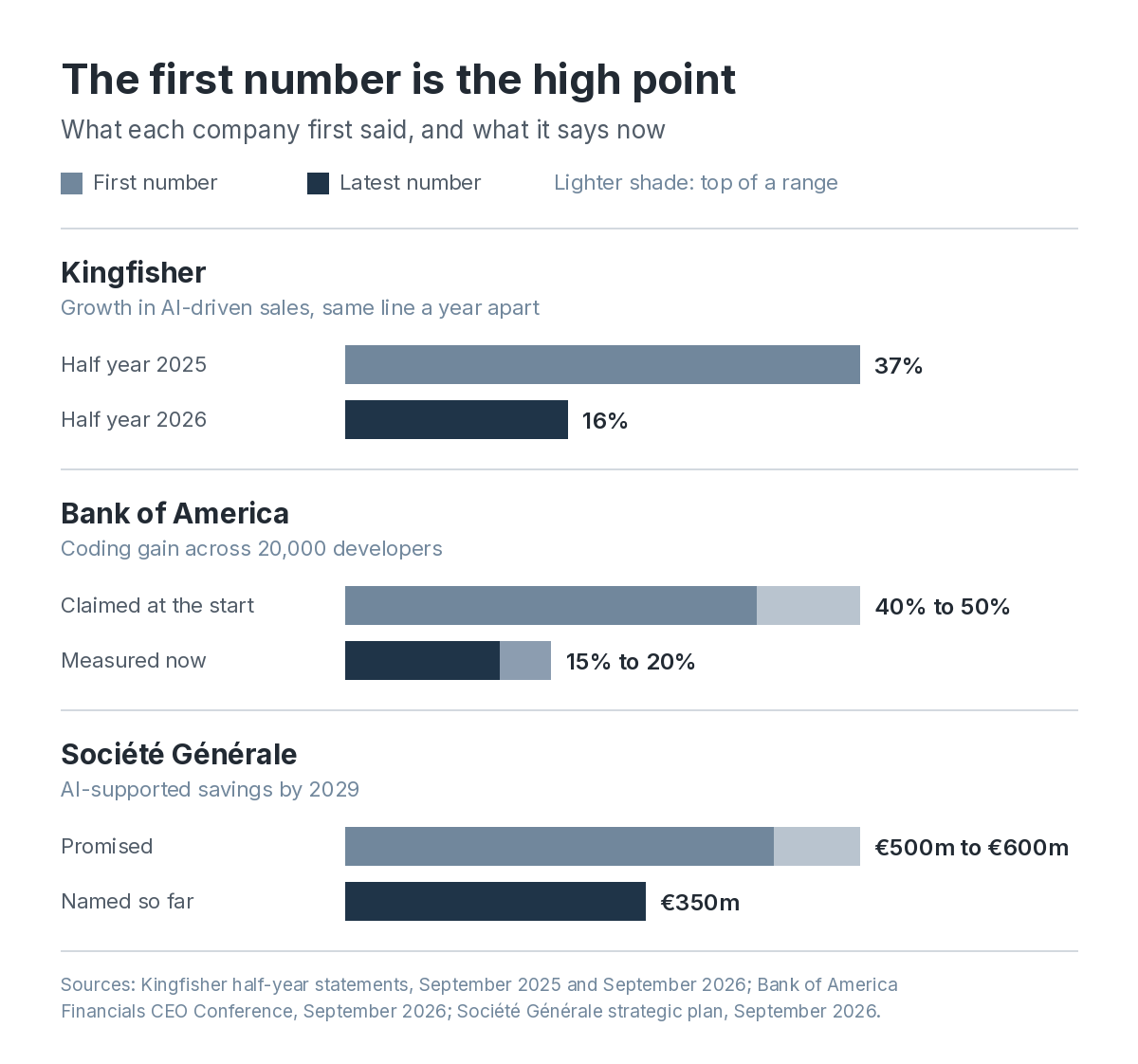
Kingfisher's half-year statement on Tuesday 22 September: "AI-driven personalisation generated c.£100m of sales, up +16%, demonstrating the growing value of our data and digital capabilities." A year ago the same line read: "Our AI-driven product recommendation and personalisation engines delivered c.£80m of Group sales in H1 25/26, up 37%YoY." These are sales Kingfisher attributes to its recommendation and personalisation engines, on a method it does not publish, so the £100m is an attributed figure rather than a measured one. The same line, measured the same way, a year apart: growth has fallen from 37% to 16%. Kingfisher was not the only company this week to compare its AI results with its original expectations. Bank of America's co-president put the coding gain across 20,000 developers at "15% to 20%" after "people threw out 40% to 50% numbers" at the start. Société Générale's plan promises €500m to €600m of AI-supported savings by 2029 and names €350m of it. AXA expects €500m to €700m a year from AI by 2029, mostly from margin and growth rather than cost cutting, and its chief executive says the figure may look different in a year.
"No, I think it is realistic as we speak today. How I will look onto it in a year's time, I do not know. I hope, again, that we have learned a lot and that we will further progress."
Thomas Buberl, Chief Executive Officer, AXA, Bank of America Financials CEO Conference, 22 September
The first-year number is usually the high point. I strongly advise planning for the restatement, and asking which of your AI figures has been measured again since it was first presented.
See also: Bank of America at financials CEO conference: growth, AI and scale [Investing.com]; ABN AMRO at Bank of America conference: progress lifts capital and costs [Investing.com]: the exception this week. Its Copilot gains came in at 25% to 30%, against the 15% to 20% it expected; AXA at Bank of America Financials CEO Conference: growth plan takes focus [Investing.com]
Standard Chartered at Bank of America conference: growth, AI and caution
Bill Winters, chief executive of Standard Chartered, told the Bank of America conference in London on Monday 22 September: "The time between the identification of a vulnerability and the ability for a bad actor to exploit that has gone from 10 to 12 days to 10 to 12 minutes as a practical matter." When he joined the bank, its internal SLA for a high-risk vulnerability "was 4 days. Well, now it's 4 minutes." Two days later, at the same conference, Bettina Orlopp of Commerzbank said her bank is spending more on cybersecurity than it planned, because of AI. The attacker's side was published the same week by Gambit Security: an operator running open-source agents almost unattended broke into at least 27 online retailers in five days, among them a Fortune 500 hospitality group and a major US airline, at an average cost of $25.46 a target.
"We invest much more than we originally thought in cybersecurity, given that AI has a lot of opportunities, but it also provides some risk."
Bettina Orlopp, Chief Executive Officer, Commerzbank, Bank of America Financials CEO Conference, 24 September
Every AI plan raises the cyber budget of the company that runs it, because the tools that write its code are writing the attacks against it, and almost no AI business case shows that line. Ask where it is.
See also: Commerzbank at Bank of America 31th Annual Financials CEO Conference: strategy holds [Investing.com]; AI Agents Are Hacking Online Retailers for $25 a Company [Gambit Security]; OpenAI hacked Medicare portal, Prime Minister Anthony Albanese says [ABC News]: the vendor noticed after two months, the government three weeks later, by email to a mailbox read once a day
The AI saving is passed straight to the customer; nothing stays in ALTEN's P&L. Its chief executive told the half-year call that AI cuts the engineers needed for the same work by about 7 per cent a year, and that clients are already asking for "a discount of 10%-15%" on the next project. The €12m spent on AI is not recovered, and the token bill is "the cost... no one has understood". The question for the board is longer term: does spending on AI that the customer keeps make the firm more competitive, or only cheaper? Transcript, 25 September
AI work is now 9 per cent of revenue, from 4 per cent a year ago: £8.1m in the first half, nearly triple. Few mid-caps report AI revenue as its own line; this is what it looks like when one does. Others that report one: Adesso in Germany (€73.7m of GenAI orders in the first half), Kontron (€120m of "physical AI" this year, targeting €1.3bn by 2030) and, at large-cap scale, Bureau Veritas (€370m of AI, cyber and data revenue, targeting €1bn by 2030). Interim results, 21 September
In the Hamburg flagship, "We used to make five million euros of annual revenue with 110 staff. Today we generate twice that with 90", the store manager told Handelsblatt, after AI took over eye checks and fitting. The group had been losing 700,000 customers a year to waiting times; its market share is up four points to 57 per cent. One store, not the group, but arithmetic a board can check. Handelsblatt, 27 September
Risk and compliance headcount "peaked at 160 people. Because of AI today, we are down to 116", heading for about 90 by year end, with 38 "digital workers" now and 101 planned, and expenses flat. A control function, a baseline, a dated target: the shape of AI return a board can audit. Sidoti conference, 24 September
The country's largest insurer now reports tokens per day as a board metric: 120bn a day at the June half-year, 210bn by August, from 30bn at the end of 2025. Against that it sets outcomes, RMB 7.1bn of fraud losses avoided and 81 per cent of customer-service contacts handled by AI, and its CFO's rule for spending: "Wherever it brings clear cost reduction, efficiency, loss reduction and service innovation in key roles and processes, we will invest in compute and talent, and keep tracking actual output and value delivery." No European insurer publishes the input side that way. Interim results, August; token update reported 23 September
Asked what stops AI-native entrants competing with it, the chief executive gave three answers: access to customers, the cost of acquiring them, and the price of AI itself. "If you build your business purely around AI, you're in for a shock in the next few years because the cost of that is going to be tremendously higher." Half-year call, 25 September
Three questions from this issue for your next board meeting.
Ilona
- For each AI initiative, what does it cost per unit, what does it return per unit, and who pays the difference until it pays back?
- Which of our AI figures has been measured again since it was first presented, and what did the second measurement show?
- What has AI added to our cyber budget this year, and is that line in the AI business case?
What should this cover?
Tell me which sectors, which sizes of company and which countries you want to see here. Replies shape the next issue.
AI ROI.
This newsletter shares its name with the book I am writing on how companies and their owners get a return from AI. Write to ilona@agentandcapital.com to hear when it is out.
A career technologist turned board director and advisor.
In executive roles at Porsche, DHL Supply Chain, Aston Martin, Innogy and ZF Foxconn I delivered ERP migrations, global infrastructure and cybersecurity builds and product-led transformations, each in under 20 months. I cut technology costs by 10 to 25 per cent, including ahead of an IPO, and quadrupled the EBITDA of a business within a year ahead of its trade sale. I closed cyber and technology risks that due diligence had missed. As founder of Agent & Capital I advise private equity sponsors and executive teams on value creation and AI governance, and work with chief executives of technology companies on what their customers need from AI. I am a Harvard Certified Corporate Director and an ISACA-certified IT auditor with its Advanced in AI Risk credential.
Get AI ROI by email every Monday at 07:00 UK time: airoi.beehiiv.com/subscribe
AI ROI is written by Ilona Simpson and published by Agent & Capital Ltd, 71-75 Shelton Street, Covent Garden, London WC2H 9JQ. Sources are linked in each item; figures are as stated by the companies and institutions named. Every figure is checked against its source, but mistakes can still happen. I correct any error in the next issue. Not investment advice. © 2026 Agent & Capital.
Get AI ROI by email every Monday at 07:00 UK time. One story each on investment, return and risk. Unsubscribe in one click.